Creatine is not a plant compound or an animal compound. It is a small molecule assembled from three amino acids, and the version sold in tubs is built in a chemical reactor rather than extracted from anything that was once alive. That single fact settles most of the confusion around vegan creatine, but it does not settle all of it, because the label on a tub is describing a finished product and not just the molecule inside it.
Your body makes about half of its own creatine
Endogenous creatine synthesis is a two step reaction. The enzyme AGAT combines glycine and arginine to form guanidinoacetate, mostly in the kidneys. Then GAMT, primarily in the liver, adds a methyl group donated by S-adenosylmethionine, which is derived from dietary methionine. The finished creatine travels through the bloodstream and is pulled into skeletal muscle by a sodium dependent transporter.
Glycine, arginine and methionine are all available in plant proteins. Legumes, soy, seeds, grains and nuts supply all three, and a vegan liver runs the same enzymatic pathway an omnivore liver does. Synthesis is not the bottleneck.
The other half of your creatine supply is dietary, and this is where the diets diverge. Preformed creatine sits in skeletal muscle tissue, which means it reaches your plate almost exclusively through meat and fish. A fully plant based diet delivers close to zero. The consequence is measurable: vegetarians and vegans tend to carry lower muscle total creatine stores and lower resting plasma creatine than omnivores eating the same total protein.
How the creatine in the tub is actually made
Commercial creatine monohydrate is synthesized industrially, not harvested. The standard route reacts sarcosine, or its sodium salt, with cyanamide under heat and controlled pH, after which the creatine crystallizes out, is washed, dried and milled. Neither starting material comes from an animal. Both are produced from industrial feedstocks at a cost far below what extracting creatine from tissue would ever run.
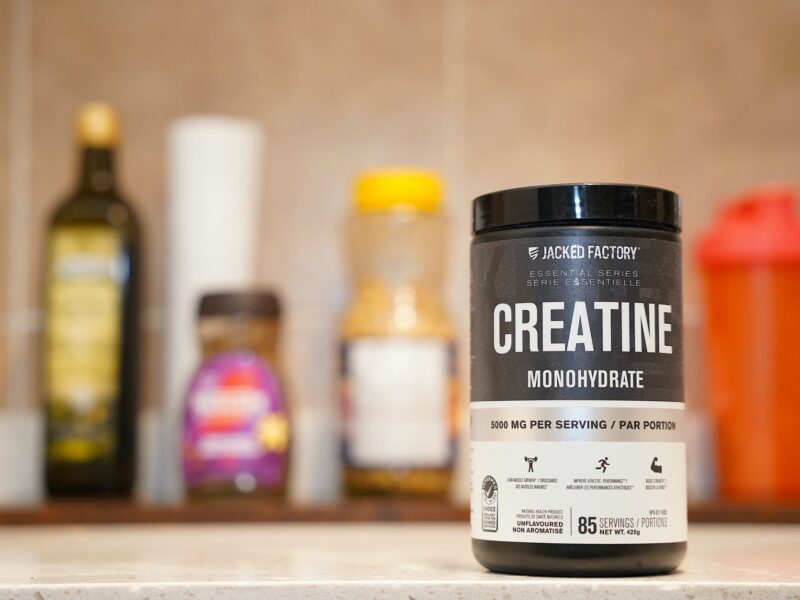
So plain creatine monohydrate powder is vegan by default. There is no separate vegan molecule, no plant sourced version with different properties, and no meaningful difference in purity, absorption or effect between a tub marked vegan and an identical unmarked tub of monohydrate. If you have read our breakdown of whether organic creatine justifies its premium, the logic here is the same. A marketing word has been attached to a synthetic compound where the word carries almost no technical meaning.
So why do some products carry a vegan label and others do not?
The molecule is the easy part. Everything around it is where animal derived material can appear.
- Capsules. This is the most common genuine issue. Standard gelatin capsules are made from bovine or porcine collagen. Vegan capsules use hydroxypropyl methylcellulose, a plant derived alternative. Powder has no such problem.
- Flavored and blended products. Once creatine is folded into a flavored formula, other ingredients enter. Whey or milk solids in a mixed muscle builder, carmine for red coloring, and vitamin D3 from lanolin are all realistic possibilities on a long ingredient list.
- Shared manufacturing lines. Some brands run creatine on equipment that also handles dairy protein. This is a cross contact question rather than an ingredient question, but it matters if you avoid animal products strictly.
- Certification cost. Plenty of unlabeled monohydrate is perfectly vegan. Third party vegan certification costs money and many commodity brands simply do not pay for it.
| Label claim | What it actually tells you |
|---|---|
| Vegan creatine | Almost nothing about the molecule. Useful only as a signal about capsules, flavorings and facility policy. |
| 100% creatine monohydrate | The one claim worth checking. A single ingredient powder has nowhere for animal derived material to hide. |
| Plant based | Marketing language with no regulatory definition for a synthetic compound. |
| Vegetarian capsules | Usually means HPMC rather than gelatin. Worth confirming in the ingredient list. |
Plant based eaters may respond more strongly
Here is the genuinely interesting part. Because vegans and vegetarians start with lower muscle creatine stores, they have more room to fill. Supplementation raises muscle creatine toward the same ceiling everyone else has, so the change from baseline can be larger.
A 2003 trial by Burke and colleagues put vegetarians and non vegetarians through eight weeks of resistance training with or without creatine. The vegetarian participants showed greater increases in muscle total creatine and lean tissue mass than the non vegetarians on the same protocol.
The pattern extends beyond muscle. Rae and colleagues gave vegetarian adults 5 grams of creatine daily for six weeks in a placebo controlled crossover design and found improvements in working memory and processing speed. Benton and Donohoe later compared vegetarians and omnivores directly and reported a memory benefit in the vegetarian group that did not appear in the omnivores. These are small studies and the cognitive literature is less settled than the strength literature, but the direction is consistent with the stores argument.
None of this makes creatine more necessary for vegans in a medical sense. It simply means the expected return on 5 grams a day is probably higher if your baseline is low.
What to actually buy
- Unflavored creatine monohydrate powder. One ingredient, no capsule shell, no flavor system, no coloring. It is the cheapest form and the most studied.
- Micronized if mixing bothers you. Micronization only reduces particle size for better suspension in water. It does not change the compound or its vegan status.
- Third party tested batches. Look for NSF Certified for Sport or Informed Choice marks. These verify identity and screen for contaminants, which matters more than any vegan claim.
- Skip the exotic forms. Hydrochloride, ethyl ester and buffered versions cost more and carry far less evidence. The International Society of Sports Nutrition position stand identifies monohydrate as the most effective and best supported form.
Dosing does not change with diet. Three to five grams daily saturates muscle stores over roughly three to four weeks, and consistency matters more than timing. Take it every day, including days you do not train, since the goal is a saturated pool rather than an acute dose. We covered why rest day dosing still counts separately.
If you are building a plant based supplement stack, creatine is one of the few additions with a strong evidence base and a clear mechanism, alongside vitamin B12 and, for many people, algal omega 3. The National Institutes of Health Office of Dietary Supplements lists creatine among the small group of performance supplements with meaningful supporting research. That is a short list, and most of what shares shelf space with it does not belong there.
References
- National Institutes of Health, Office of Dietary Supplements. Dietary Supplements for Exercise and Athletic Performance: Fact Sheet for Health Professionals.
- Kreider RB, et al. International Society of Sports Nutrition position stand: safety and efficacy of creatine supplementation in exercise, sport, and medicine. Journal of the International Society of Sports Nutrition. 2017.
- Burke DG, et al. Effect of creatine and weight training on muscle creatine and performance in vegetarians. Medicine and Science in Sports and Exercise. 2003.
- Rae C, et al. Oral creatine monohydrate supplementation improves brain performance: a double-blind, placebo-controlled, cross-over trial. Proceedings of the Royal Society B: Biological Sciences. 2003.
- Benton D, Donohoe R. The influence of creatine supplementation on the cognitive functioning of vegetarians and omnivores. British Journal of Nutrition. 2011.