Most supplement labels either say “take with a meal” or say nothing at all, and neither tells you why. The answer usually comes down to three questions: does the nutrient need dietary fat to be absorbed, does it irritate an empty stomach, and does it compete with something else in the same capsule or the same meal. Get those three right and the rest of the timing advice you see online stops mattering much.
Fat-Soluble Vitamins Genuinely Need Fat
Vitamins A, D, E, and K dissolve in fat, not water. They are absorbed in the small intestine along with dietary lipids, packaged into micelles with bile acids, and carried into circulation with fats from the meal. Take them with black coffee and you have made absorption harder than it needs to be.
Vitamin D is the one most people supplement daily, and small trials have found that taking it with the largest meal of the day produces higher blood levels of 25-hydroxyvitamin D than taking it fasted or with a light snack. The NIH Office of Dietary Supplements notes that vitamin D requires fat for absorption and that people with fat malabsorption conditions absorb less. If you are also taking K2 alongside it, the same rule applies to both, since vitamin K is fat-soluble too and pairs naturally with D in the same dose.
You do not need a large meal. Roughly 10 to 15 grams of fat, which is about a tablespoon of olive oil, a handful of nuts, or two eggs, is enough to do the job.
The Quick Reference Table
| Supplement | Take with food? | Reason |
|---|---|---|
| Vitamin D, A, E, K | Yes, with fat | Fat-soluble, absorption depends on dietary lipids |
| Fish oil / omega-3 | Yes | Better absorption and far fewer fishy burps |
| Iron | Empty stomach if tolerated | Food reduces absorption, but nausea is common |
| Calcium carbonate | Yes | Needs stomach acid to dissolve |
| Calcium citrate | Either | Dissolves without acid |
| Magnesium | Yes | Reduces loose stools and cramping |
| Zinc | With a small meal | Absorbs better fasted but frequently causes nausea |
| Multivitamin | Yes | Contains fat-soluble vitamins and minerals |
| Creatine | Either | Total daily intake matters, timing does not |
| Protein powder | Either | It is food |
Iron Is the Awkward Exception
Iron is the clearest case where the pharmacology and the practicality disagree. Absorption of non-heme iron is meaningfully higher on an empty stomach, and it is reduced by calcium, by the polyphenols in coffee and tea, and by phytates in whole grains and legumes. Vitamin C in the same meal improves uptake. The ODS iron fact sheet covers these interactions in detail.
The problem is that iron on an empty stomach causes nausea, cramping, and constipation in a large share of people. An iron supplement you actually take with breakfast beats an ideal one you abandon after five days. If you need iron for a diagnosed deficiency, take it away from coffee, tea, and calcium supplements, add a source of vitamin C, and accept a small absorption penalty from food if that is what makes it tolerable.
Minerals Compete With Each Other
At normal dietary levels this rarely matters. At supplemental doses it can. Calcium and iron share absorption pathways, which is why calcium supplements are usually recommended separately from iron. High-dose zinc taken continuously for months can interfere with copper status, which is why the tolerable upper intake level for zinc in adults is 40 mg per day from all sources.
A practical split for anyone taking several minerals:
- Morning with breakfast: multivitamin, vitamin D, omega-3
- Midday or between meals: iron, if prescribed, with a vitamin C source
- Evening with dinner: magnesium, calcium if you take it
Magnesium and the Gut Tolerance Question
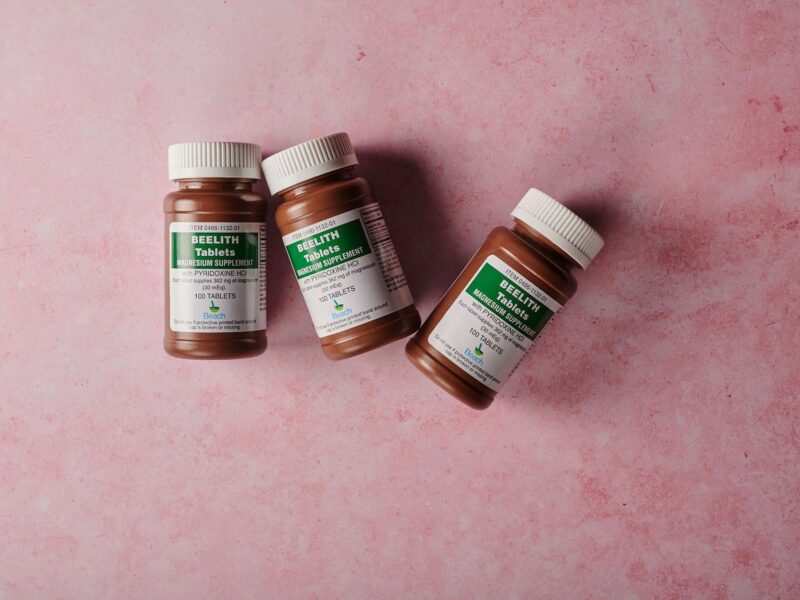
Magnesium is less about absorption and more about comfort. The oxide form is poorly absorbed and pulls water into the intestine, which is exactly why it works as a laxative. Glycinate and citrate are absorbed more readily and are gentler, though citrate still loosens stools at higher doses. The ODS magnesium fact sheet notes that forms dissolving well in liquid are more completely absorbed than less soluble forms. Taking it with dinner slows gastric emptying slightly and tends to reduce the urgency problem. If you are still deciding which version to buy, the differences between glycinate, citrate, and oxide are worth understanding before you look at timing at all.
Where Food Timing Is Mostly Noise
Some supplements attract timing advice they do not deserve.
- Creatine monohydrate. Muscle saturation is driven by consistent daily intake. Carbohydrate co-ingestion may modestly increase uptake during a loading phase, but the effect is small relative to simply taking it every day.
- Protein powder. It is a food. Absorption rate differs between whey, casein, and plant blends, but there is no meal requirement.
- Probiotics. Manufacturers make confident claims about fasted versus fed dosing. The published evidence is inconsistent and strain dependent, so consistency matters more than clock time.
- Water-soluble B vitamins and vitamin C. Absorbed fine either way. Some people get nausea from B complex or zinc-containing formulas on an empty stomach, which is the only real argument for food here.
Melatonin runs the other way: the hour you take it genuinely matters, while the amount most people swallow is far higher than the evidence supports.
The Rule That Beats All the Others
Adherence outperforms optimization. A supplement taken five days a week at the theoretically perfect moment does less for you than the same supplement taken seven days a week attached to a meal you never skip. Anchor your stack to a habit that already exists, keep fat-soluble vitamins with a meal containing some fat, keep iron away from calcium and coffee, and stop worrying about the rest.
One caveat worth stating: medications change this calculus. Thyroid hormone, certain antibiotics, and some osteoporosis drugs have strict food and mineral separation requirements. If you take prescription medication, check the interaction with your pharmacist rather than assuming the general rules above apply.
References
- National Institutes of Health, Office of Dietary Supplements. Vitamin D: Fact Sheet for Health Professionals.
- National Institutes of Health, Office of Dietary Supplements. Iron: Fact Sheet for Health Professionals.
- National Institutes of Health, Office of Dietary Supplements. Calcium: Fact Sheet for Health Professionals.
- National Institutes of Health, Office of Dietary Supplements. Magnesium: Fact Sheet for Health Professionals.
- National Institutes of Health, Office of Dietary Supplements. Zinc: Fact Sheet for Health Professionals.