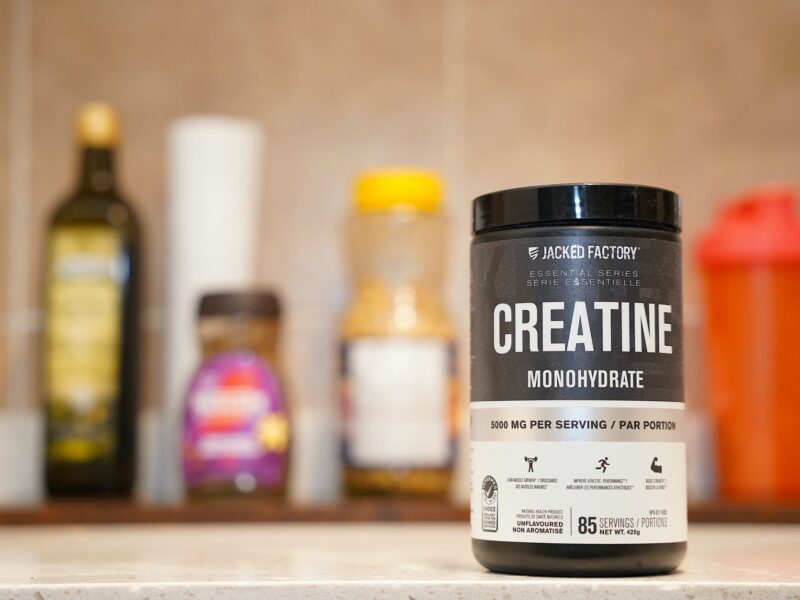
Most of the creatine in your body sits inside skeletal muscle, stored as phosphocreatine, a rapid energy reserve your muscles tap during short bursts of effort. Daily supplementation pushes those stores roughly 20 to 40 percent above their natural baseline. When you stop, the interesting question is not whether your levels fall, because they do, but how fast, how far, and what you actually lose along the way.
Your muscle creatine stores drift back to baseline
When you stop supplementing, your body keeps doing what it always did. Your liver, kidneys, and pancreas synthesize roughly 1 to 2 grams of creatine per day from the amino acids arginine, glycine, and methionine, and you absorb more from meat and fish if you eat them. What stops is the surplus that supplementation was maintaining.
Classic muscle biopsy research by Hultman and colleagues found that after a loading protocol, elevated muscle creatine gradually returned to pre-supplementation levels over about four weeks. That is the number worth anchoring to. There is no sudden crash and no withdrawal. Instead you get a slow, steady decline back to where your muscles naturally sit.
| Time after stopping | What is happening |
|---|---|
| Days 1 to 7 | Intracellular water starts to normalize; slight drop on the scale |
| Weeks 1 to 3 | Muscle creatine stores steadily decline toward baseline |
| Around week 4 | Stores typically back to natural pre-supplement levels |
| Beyond week 4 | Endogenous production continues as normal |
The scale drops, but it is mostly water
The first thing most people notice is a small drop in body weight, often one to four pounds within a couple of weeks. This is not fat loss and it is not muscle loss. Creatine draws water into the muscle cell, so higher stores mean more intracellular fluid. Take away the surplus and that extra fluid leaves with it. If you want the full mechanism behind that fluid shift, we covered it in detail in our piece on what creatine actually does to water in your muscles.
Because part of creatine’s fullness effect comes from cell hydration, some people feel their muscles look slightly flatter after stopping. That visual change is cosmetic and reversible. It says nothing about the muscle tissue you built.
Do you lose strength and muscle?
This is the fear, and the honest answer is nuanced. You lose the ergogenic edge, not the physique.
- Contractile muscle you built stays. The lean tissue you gained through months of training is protein, not water. It does not disappear because you stopped a supplement.
- Peak performance may dip slightly. With less phosphocreatine available, your capacity for those final hard reps and repeated maximal efforts can decline modestly. You may find you get one or two fewer reps at a heavy weight.
- The effect is small for most people. Reviews of creatine research consistently show the performance benefit is meaningful but not dramatic, so losing it is not dramatic either.
In practice, a lifter who stops creatine but keeps training and eating well will largely hold onto their strength. What fades is the assist creatine was providing during high-intensity sets, not the adaptations training produced.
Does your body stop making its own creatine?
During supplementation, the body does downregulate some of its own creatine synthesis, which is a normal feedback response rather than a warning sign. The concern people raise is whether stopping leaves you permanently depleted. Current evidence does not support that. The International Society of Sports Nutrition position stand reports no evidence that endogenous production is permanently suppressed, and synthesis resumes as levels fall. This is one reason the same body of research finds long term daily use to be well tolerated in healthy people.
So should you cycle creatine on and off?
Cycling means deliberately taking creatine for a block, stopping, then restarting. For most healthy adults using standard creatine monohydrate, there is no physiological reason to do this. Creatine works by keeping your muscle stores saturated. Cycling off simply lets them drain, then requires you to spend weeks resaturating them, which means periods of reduced benefit for no clear payoff.
The maintenance model is far simpler. Research supports a daily dose of around 3 to 5 grams to keep stores topped up indefinitely. Because saturation is the whole game, consistency matters more than timing, which is also why questions like whether the hour you take it makes any difference tend to matter less than people assume.
Reasons someone might stop anyway
- They are taking a break from structured training and do not feel the supplement is worth it during that stretch.
- They want to reduce the small water weight before an event where scale numbers matter, such as a weigh-in.
- They experience digestive discomfort at a given dose and want to reset, though splitting the dose often solves this. The same goes for swallowing the powder dry instead of mixing it, which tends to make that discomfort worse rather than better.
None of these require a formal cycle. You can stop whenever you like and restart whenever you like. If you restart, you do not strictly need a loading phase again; a steady daily dose will resaturate your muscles over about three to four weeks.
The bottom line
Stopping creatine is uneventful. Over roughly four weeks your muscle stores return to their natural baseline, you shed a small amount of water weight, and you lose the performance assist creatine provided during hard efforts. What you keep is the muscle and strength your training earned. There is no rebound penalty, no permanent shutdown of your own production, and no compelling reason to cycle it. For most people the practical choice is binary: take it daily to stay saturated, or stop and accept a gentle return to baseline.
References
- Kreider RB, et al. International Society of Sports Nutrition position stand: safety and efficacy of creatine supplementation. Journal of the International Society of Sports Nutrition. 2017.
- Hultman E, et al. Muscle creatine loading in men. Journal of Applied Physiology. 1996.
- National Institutes of Health, Office of Dietary Supplements. Dietary Supplements for Exercise and Athletic Performance. NIH. 2023.
- Persky AM, Brazeau GA. Clinical pharmacology of the dietary supplement creatine monohydrate. Pharmacological Reviews. 2001.